
Visa application
International attendees (and accompanying family members) planning to travel to Brazil for IWOMP 2014 should be well informed and adequately prepared for the Brazil visa application process, and should start the process as soon as they know of their intent to travel. Brazil applies the reciprocity principle for its visa policy. This means that the fees and requirements to get a Brazilian visa are the same as those applied by your country to Brazilian citizens.Holders of passports of some countries do not require a visa to visit Brazil up to 90 days for tourism or business purposes (unless otherwise noted). If you are citizen from the Mercosul community, you can travel with only your identity document. Otherwise, a valid passport is required. Please, check the expiration date of your passport to see if it covers the period required (at least six months from date of entry in Brazil). The link http://www.portalconsular.mre.gov.br/estrangeiros/qgrv-simples-ing-09.01.2014.pdf/at_download/file shows visa requirements by country .
For some countries, you are required to have a visa issued 90 days prior to your first arrival in Brazil. You can apply for a short stay visa at the Brazilian embassy or consulate in your country. Please, check the Brazilian embassy/consulate site in your country in advance to verify how long the visa process takes, since it depends on each country. In general, you should present the following documents to apply for a visa: “Visa Application Form " duly completed at https://scedv.serpro.gov.br, valid travel document ( passport with, at least, 6 months validity), proof of payment of consular fees and others specific documents for the type of visa required.
Please note that each embassy or consulate may ask you for extra documents or items. For more information, see http://www.portalconsular.mre.gov.br/
About Salvador
The first Brazilian capital, Salvador is located on the northeast coast of Brazil on the Atlantic Ocean and is the third largest city in Brazil. Salvador has a tropical climate including rainforests and lush vegetation. The cuisine in Salvador consists of spicy seafood and the culture is one of the most distinguished on the planet. Visiting a Salvador beach is a highlight for many tourists. The northeast region of Salvador concentrates most beaches with good water quality. Flamengo and Stella Maris are the most popular beaches among tourists and upper class locals. They have excellent tourist infrastructure and rough waters excellent for surfing. Jaguaribe, Piatã and Itapoã, with calmer waters, are mostly frequented by locals and can become quite crowded at weekends. Local residents enjoy sharing their exotic dancing and music skills with tourists. Residents are also considered some of the friendliest and most outgoing people in Brazil. Tourists are welcomed with open and friendly arms by the majority of local residents.
Salvador’s Attractions
|
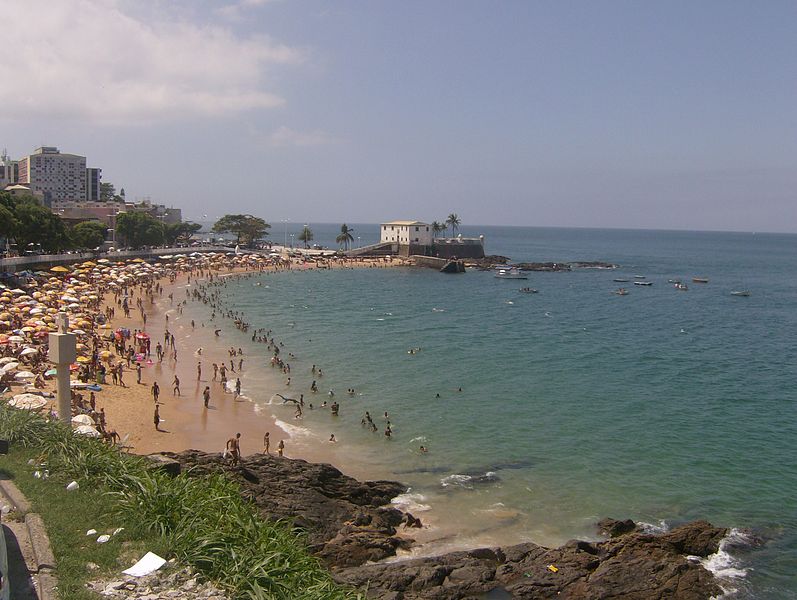
Porto da Barra – The beach is set within the bay and the water is much calmer than on the oceanside beaches what is good for swimming. Its landscape is very reminiscent of the beaches of Rio de Janeiro, since the visitors spread in the sand instead of tents. Diving, volleyball and racquetball sports are quite practiced at the site, especially during the week. |
|
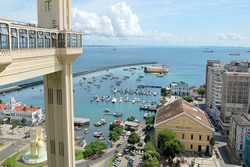
Elevador Lacerda – One of the most famous postcards of Salvador, it was inaugurated in 1873. It was built to improve the connection between the higher and lower part of the city. You travel more than 70 meters in one of the tallest public elevators in the world. Jesuits installed the first manual rope-and-pulley elevator around 1610 to more easily transport goods and passengers from the port to the settlement. In 1868 an iron structure with clanking steam elevators was inaugurated, replaced by an electric system in 1928. The elevador Lacerda yet brings a curious fact, two of its four cabins pass inside a rock. |
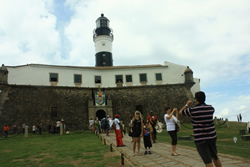
Font: http://bahia.com.br/atracao/farol-da-barra-forte-de-santo-antonio-da-barra/ |
Farol da Barra - Built in 1534, it is the first Brazil’s lighthouse and the oldest in South America. It’s located in the Barra neighborhood at Ponta do Padrão, one of the points which delimit the Baía de Todos-os-Santos. After a lot of wreck in this area, it was built to aid the navigation. It also played a major role at independence war when the natives fought against Dutchs. |
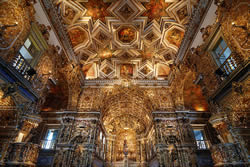
Font: http://pt.wikipedia.org/wiki/Igreja-e-Convento-de-Sao-Francisco-(Salvador) |
Igreja de São Francisco - It’s hard to miss the significance of religion and spirituality in Salvador with 365 Catholic churches spread across Salvador. The oldest of these churches, clustered in historic Pelourinho, date back to the 1700s and boast well-preserved Baroque and colonial architecture. São Francisco may be the most boastful, though, with its ornate interior coated with gold leaf -- some say 1 ton of gold leaf. It’s hard to question the figure when you spy the gleaming altar. Outside, the convent courtyard features gorgeous blue and white hand-painted Portuguese tiles. Many of the cherubs and other religious ornamentation in the church appear a bit odd and distorted. They were the handiwork of disgruntled slave artisans who were forced into Catholicism and decorated the church with pregnant cherubs and other figures distasteful to their captors. |
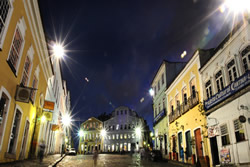
Font: http://bahia.com.br/noticias/pelourinho-impossivel-visitar-salvador-e-nao-passar-por-la/ |
Largo do Pelourinho - Salvador’s restored colonial square is the epicenter of Brazilian culture and a UNESCO World Heritage Site. Its dark past as a slave-trading market and whipping post or pillory (pelourinho in Portuguese) is almost hidden behind a brighter present: Pretty pastel pink, yellow and blue buildings serve as the backdrop to wandering tourists, Bahian vendors and impromptu capoeira demonstrations -- an acrobatic display of martial arts and dance performed to drums. If you happen to be in Salvador for Carnival, you can join the crush of drummers, dancers, bands and other revelers squeezing into the square for a last run at debauchery on the eve of Lent. Be sure to look out for Carnival favorites such as the Sons of Gandhi, or “Filhos de Ghandhy,” as the locals call them. Thousands of men in white turbans sing chants of African origin. Meanwhile, the Afro-Brazilian group Ilê Aiyê parades in its trademark yellow, red and black garb. And the cultural group Olodum showcases its infectious samba reggae beats -- a unique mix of merengue, salsa and reggae rhythms. |